Estimated article reading time
A practical tourism operations article from Ahmed Mahmoud, structured for focused reading and recruiter review.
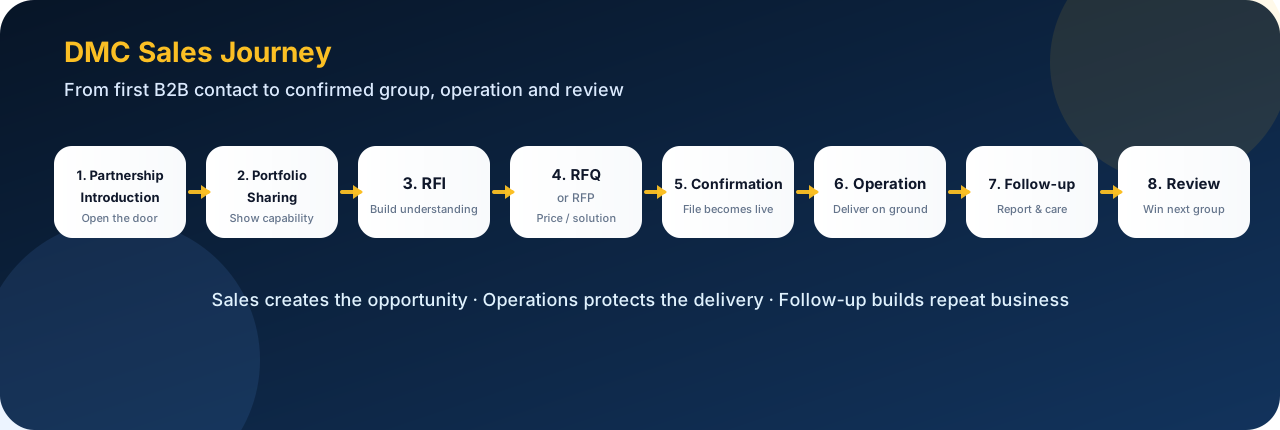
Introduction: Why These Terms Matter in Tourism Sales
In tourism, many people think sales starts when a client asks for a price. In reality, sales often starts much earlier.
Sometimes a travel agency is only collecting information. Sometimes a corporate client already knows exactly what they want and only needs a quotation. Sometimes an international tour operator is comparing several DMCs before choosing one local partner. Sometimes a MICE client is preparing a large event and needs a full proposal with hotels, transport, guides, venues, activities, pricing, terms and operational support.
This is where terms like RFI, RFQ, RFP, eRFP and NDA become very important.
For someone working in a DMC, tour operator, hotel, travel agency, MICE department, or tourism sales team, understanding these terms is not just “business vocabulary.” It is part of professional communication. It helps you know what the client really wants, how much detail you should provide, how fast you should respond, and how to protect your company’s information.
A good tourism salesperson does not reply to every request in the same way. An RFI needs one type of response. An RFQ needs another. An RFP needs a much deeper proposal. An NDA must be handled carefully because it may involve confidential information.
If the sales team misunderstands the request, many problems can happen. They may send a simple price when the client expected a full proposal. They may spend hours creating a detailed itinerary when the client only needed basic information. They may share confidential rates without protection. They may miss the deadline because they did not understand that the request was part of a formal procurement process.
This article explains the difference between RFI, RFQ, RFP, eRFP and NDA from a practical tourism and DMC sales point of view. The goal is simple: to help tourism professionals respond better, look more professional, and increase their chances of winning business.
What Is an RFI?
RFI means Request for Information.
An RFI is usually sent when the client is still in the research stage. They are not always ready to buy yet. They may be trying to understand the market, check what services are available, compare potential suppliers, or collect information before preparing a more serious request later.
In tourism, an RFI can come from a travel agency, tour operator, corporate client, event company, school, government entity, or international partner. The client may ask questions such as:
- What services do you provide in Abu Dhabi?
- Do you handle French-speaking groups?
- Can you support MICE groups?
- Do you provide licensed tour guides?
- Do you work with hotels, attractions and transport companies?
- Can you manage airport transfers and city tours?
- Do you have experience with VIP guests?
- What destinations do you cover?
- What is your company profile?
- Can you share examples of past services?
At this stage, the client may not ask for detailed prices. They may not even have final dates or confirmed guest numbers. They are simply trying to understand if your company is the right partner.
Tourism Example of an RFI
Imagine a French tour operator is planning to launch a new UAE program for next season. They do not yet have confirmed group dates. They are still studying the destination and comparing possible DMC partners.
They may send an email like this:
“Dear Team, We are currently exploring potential DMC partners in Abu Dhabi and Dubai for a future leisure group series. Could you please share your company profile, destination coverage, guide language availability, sample itineraries and general service scope?”
This is an RFI.
They are not asking for a final quotation yet. They are asking for information to decide whether your company should be considered for future business.
Related reading: When this early request becomes a real price request, continue with How to Quote a City Tour Professionally. When the confirmed group becomes a live movement, read Tourism Operations Roles.
How a DMC Should Respond to an RFI
The response to an RFI should be professional, clear and informative. It should not be overloaded with too many prices unless the client asks for them.
A good RFI response may include:
- A short company introduction.
- Destination coverage.
- Core services.
- Languages available.
- Types of clients served.
- Sample itineraries.
- Operational strengths.
- Contact person for follow-up.
- Company profile or presentation.
- Website or portfolio link.
The goal is to build trust and position your company as a serious local expert.
For example, a DMC can reply:
“Thank you for considering us as a potential DMC partner in the UAE. We support leisure groups, MICE programs, FIT arrangements, transfers, guided tours, attraction bookings and destination experiences across Abu Dhabi and Dubai. We can provide licensed guides in English, French, German, Spanish, Italian and other languages based on availability. Please find attached our company profile and sample Abu Dhabi itineraries for your reference.”
This type of reply gives the client confidence without treating the request like a final confirmed booking.
What Is an RFQ?
RFQ means Request for Quotation.
An RFQ is more specific than an RFI. It means the client already knows what they need and is asking for prices.
In tourism, an RFQ usually includes clearer details such as date, number of guests, service type, pickup location, itinerary, hotel category, vehicle type, meal requirement, guide language, or attraction tickets.
The client may not need a creative proposal. They may simply need a price for a specific service.
Tourism Example of an RFQ
A travel agency may send this request:
“Please quote for the following service: Date: 15 October 2026 Guests: 25 adults Service: Abu Dhabi city tour Pickup: Hotel in Yas Island Language: French-speaking guide Inclusions: Sheikh Zayed Grand Mosque, Qasr Al Watan, Louvre Abu Dhabi, transport and guide Please provide your best net rate.”
This is an RFQ.
The client has already defined what they want. They are asking for a quotation.
What Should Be Included in an RFQ Response?
A good RFQ response should be clear, accurate and easy to compare. Tourism clients often send the same RFQ to several DMCs, so your quotation must be professional and easy to understand.
A strong RFQ response may include:
- Service name.
- Date of service.
- Number of guests.
- Vehicle type.
- Guide language.
- Inclusions.
- Exclusions.
- Net rate or selling rate.
- Validity of quotation.
- Payment terms.
- Cancellation policy.
- Important operational notes.
- Child policy if applicable.
- Ticket conditions if attractions are included.
- Any assumptions used in the quotation.
For example:
“Based on 25 adults, we are pleased to offer the Abu Dhabi city tour with French-speaking licensed guide, private coach transportation, Louvre Abu Dhabi entrance tickets and Qasr Al Watan entrance tickets. The rate is valid for the requested date only and subject to availability at the time of booking.”
This is much better than sending only a number. In tourism, a price without conditions can create problems later.
Common Mistake in RFQ Responses
One common mistake is sending a quotation without explaining what is included and what is excluded.
For example, if you write:
“Abu Dhabi city tour: AED 250 per person”
The client may later assume that all tickets, meals, guide, transport, parking, water, taxes and pickup are included. If that was not your intention, the problem becomes yours.
A professional RFQ response must remove confusion before it becomes a complaint.
What Is an RFP?
RFP means Request for Proposal.
An RFP is deeper than an RFQ. The client is not only asking for a price. They are asking for a complete solution.
In tourism, an RFP is common in MICE, corporate travel, government projects, large group movements, incentive trips, event logistics, destination programs and long-term partnerships.
An RFP may require the DMC to propose:
- Program concept.
- Itinerary design.
- Hotels.
- Transport plan.
- Guide and staffing plan.
- Attractions and experiences.
- Gala dinner or venue options.
- Branding ideas.
- Guest flow.
- Risk management.
- Contingency plans.
- Pricing structure.
- Terms and conditions.
- Company credentials.
- Operational methodology.
- Team structure.
- Similar past experience.
An RFP is not just “how much?” It is “what is your best solution and why should we choose you?”
Tourism Example of an RFP
A corporate client may send this:
“We are organizing an incentive trip to Abu Dhabi for 120 guests from Europe. The program will be 4 days / 3 nights and should include airport transfers, hotel accommodation, daily activities, gala dinner, team-building activity, cultural experience, desert evening, French-speaking support team and full ground handling. Please submit your proposal including itinerary, pricing, operational plan, service inclusions, exclusions, terms and company credentials.”
This is an RFP.
The client expects a professional proposal, not just a price table.
How a DMC Should Respond to an RFP
A strong RFP response should feel like a complete business proposal. It should show that you understand the client’s goals, not only the destination.
The response should usually include:
Executive Summary A short overview of your understanding of the request and your proposed approach.
Company Introduction Who you are, what you do, and why your company is qualified.
Client Requirement Understanding A summary of what the client needs, proving that you read the request carefully.
Proposed Program or Solution The itinerary, services, activities, hotels, venues and operational concept.
Operational Plan Pickup timing, staffing, transport, guide allocation, guest handling, language support and backup plan.
Pricing Clear rates, inclusions, exclusions, optional upgrades and commercial conditions.
Terms and Conditions Payment, cancellation, validity, availability, taxes, ticket policy and force majeure.
Why Choose Us Your strengths, destination knowledge, local network, service quality and experience.
Next Steps How the client can confirm, ask questions or request revisions.
A good RFP response is not only informative. It is persuasive.
It should make the client feel: “This team understands our needs. They are organized. They can manage the operation.”
RFI vs RFQ vs RFP: The Simple Difference
The easiest way to understand the difference is this:
RFI asks: “Who are you and what can you do?” RFQ asks: “How much will this specific service cost?” RFP asks: “What complete solution can you propose for our need?”
Here is a simple comparison:
| Term | Full Name | Client Stage | Main Purpose | Typical Tourism Example |
|---|---|---|---|---|
| RFI | Request for Information | Research stage | Collect supplier information | “Can you share your DMC profile and destination coverage?” |
| RFQ | Request for Quotation | Price comparison stage | Get prices for a defined service | “Please quote for 30 pax Abu Dhabi city tour with guide and transport.” |
| RFP | Request for Proposal | Solution selection stage | Receive a full proposal | “Please propose a 4-day incentive program for 120 guests.” |
| eRFP | Electronic Request for Proposal | Online procurement stage | Submit proposal through a platform | “Please upload your proposal and pricing on the client portal.” |
| NDA | Non-Disclosure Agreement | Confidentiality stage | Protect sensitive information | “Please sign the NDA before we share guest details or event budget.” |
This table is simple, but it can save many hours of confusion inside a sales office.
How a Master Quotation Supports RFQ and RFP Responses
One important point for tourism sales teams is that RFQ and RFP responses should not always be built from zero.
In a professional DMC environment, the sales team can use a master quotation structure to make responses faster, clearer and more consistent. This is especially useful when the company receives repeated requests for city tours, transfers, attraction packages, MICE programs, airport services, hotel combinations or group movements.
A master quotation is not only a price sheet. It is a working commercial tool that helps the team organize the full pricing logic behind the quotation.
For example, a strong master quotation can include:
- Fixed costs such as guide fees, vehicle rental, parking, permits or coordination charges.
- Variable costs such as attraction tickets, meals, water, guest count changes and optional services.
- Adult, child, junior and infant pricing rules.
- Hotel pickup zones and transport assumptions.
- Supplier rates and validity periods.
- Inclusions and exclusions.
- Cancellation and payment terms.
- Optional upgrades.
- Seasonal notes.
- Operational remarks that affect pricing.
This connects directly with the idea of the Tour Quotation & Pricing Masterclass. Before sending a professional RFQ or RFP response, the tourism salesperson must understand how the price is built. A quotation should not be only a final number. It should be based on clear cost logic, supplier rules, guest count, itinerary design and operational reality.
For example, if a client sends an RFQ for an Abu Dhabi city tour, the master quotation can help the team quickly calculate the price based on the number of guests, vehicle type, guide language, attraction tickets and pickup zone. If the client sends an RFP for a full group program, the same master quotation logic can support the proposal by giving accurate cost components for each day of the itinerary.
This makes the sales process stronger because the team can respond faster without losing accuracy. It also reduces mistakes, especially when several people are preparing quotations for different clients.
In tourism sales, speed is important, but speed without structure can create problems. A master quotation gives the team both speed and control.
It also helps the company maintain consistency. Two salespeople should not quote the same service in completely different ways unless there is a clear reason. When the team works from one organized quotation structure, the client receives a more professional and reliable response.
This is why RFQ and RFP knowledge should not be separated from pricing knowledge. The document type tells you how to respond, but the master quotation helps you know what to calculate, what to include and what conditions to mention.
For teams that want to improve the pricing side of RFQ and RFP responses, the next step is to build a clear quotation structure. This is explained in the Tour Quotation & Pricing Masterclass, which covers how tourism prices are built from fixed costs, variable costs, supplier rules and operational assumptions.
A well-prepared master quotation can turn the sales response from a simple price reply into a structured commercial answer.
What Is an eRFP?
eRFP means Electronic Request for Proposal.
It is basically an RFP submitted through an online system, platform, portal or procurement tool.
Instead of sending the proposal by email, the client may ask suppliers to log in to a system and upload their answers. This is common with large corporations, government entities, international event agencies, hotel chains and procurement departments.
The platform may require the supplier to fill in many sections, such as:
- Company details.
- Legal documents.
- Trade license.
- Insurance documents.
- Tax information.
- Service descriptions.
- Technical proposal.
- Commercial proposal.
- Pricing tables.
- Attachments.
- Compliance questions.
- Deadline confirmation.
Tourism Example of an eRFP
A global company is planning a conference in Abu Dhabi. Instead of asking DMCs to email proposals, they send access to an online procurement portal.
The DMC must log in, answer all questions, upload the company profile, submit pricing, confirm compliance, and complete the proposal before the deadline.
This is an eRFP.
Why eRFPs Need Special Attention
An eRFP can be more complicated than a normal email request. Sometimes the system closes exactly at the deadline. If you are late by one minute, you may not be able to submit.
Also, some portals require specific formats. For example, they may ask for prices in Excel, technical answers in PDF, company documents in separate uploads, and answers to mandatory questions.
A tourism sales team should treat an eRFP like a project, not like a normal email.
Before starting, the team should check:
- Submission deadline.
- Time zone of the deadline.
- Required documents.
- File format.
- Mandatory questions.
- Pricing structure.
- Whether the commercial proposal and technical proposal must be uploaded separately.
- Whether suppliers can ask clarification questions.
- Whether the client allows alternative proposals.
- Whether the system allows changes after submission.
A small mistake in an eRFP can disqualify a strong proposal.
What Is an NDA?
NDA means Non-Disclosure Agreement.
An NDA is a legal agreement used to protect confidential information. In tourism sales, an NDA may be signed before sharing sensitive details between the client and the supplier.
Many tourism professionals think NDAs are only for big companies or legal departments. But in real tourism operations, confidential information appears often.
For example, confidential information in tourism usually falls into three practical groups:
Commercial & supplier data
Special hotel rates, net DMC rates, supplier contracts, corporate budgets and procurement documents.
Guest & client identity
VIP names, celebrity or royal movements, passport copies, delegate lists, rooming lists and internal client data.
Operation & event details
Confidential itineraries, security arrangements, private aircraft or transfer movements, event floor plans and unpublished product launches.
If this information is shared without protection, it can create serious problems.
Tourism Example of an NDA
A luxury brand is planning a private event in Abu Dhabi. They do not want the event details, guest names, hotel location or program concept to become public.
Before sharing the full brief, they ask the DMC to sign an NDA.
Only after signing the NDA do they share the event details.
In this case, the NDA protects the client and also protects the DMC because both sides know how confidential information should be handled.
When Should a DMC Ask for an NDA?
Sometimes the client asks for the NDA. But sometimes the DMC should also consider requesting one.
For example, if your company is sharing a very detailed proposal, unique itinerary concept, supplier contacts, creative event ideas or special rates, you may want confidentiality protection.
This is especially important when the proposal includes original work that could be copied and used with another supplier.
A DMC should never treat confidential information casually. Even a simple WhatsApp message with guest details can become a risk if it is shared with the wrong person.
The Sales Journey: How These Documents Connect
RFI, RFQ, RFP, eRFP and NDA are not separate worlds. In many cases, they are part of the same sales journey.
A client may start with an RFI, then send an RFP, then request an NDA, then ask for an RFQ for specific services.
For example:
Step 1: RFI
A European tour operator asks for your company profile and sample UAE programs.
Step 2: NDA
Before sharing their confidential client details, they ask you to sign an NDA.
Step 3: RFP
They send a complete request for a 5-day incentive trip in Abu Dhabi.
Step 4: RFQ
After reviewing your proposal, they ask for revised pricing for specific hotel categories, transport options and optional activities.
Step 5: Confirmation
Once pricing is approved, the request moves to booking, operations, supplier confirmation and final guest handling.
This is why tourism sales teams must understand the full process. A request is not always a simple email. It can be part of a bigger business opportunity.
From Partnership Introduction to Confirmed Group: A Real-Life DMC Sales Scenario
Definitions are useful, but tourism sales becomes much clearer when we follow the full journey from the first outreach email to the moment the guests leave and the partner sends feedback.
In real DMC work, a business opportunity does not always begin with a formal RFP. Many opportunities begin with a simple but professional partnership introduction. A sales person introduces the company, shares the company portfolio, opens the relationship and explains how the DMC can support future requests. Later, that introduction may become an RFI, then an RFQ, then a complete RFP, and finally a confirmed operation.
Let us imagine a practical situation.
Ahmed works in the sales team of Company X, a UAE-based destination management company. Company X supports international travel partners with airport transfers, hotel coordination, city tours, attraction tickets, multilingual guides, MICE support, group logistics, FIT arrangements, VIP handling and tailor-made destination programs across Abu Dhabi, Dubai and selected UAE regions.
Ahmed is not contacting the UK market as an individual tour guide. He is contacting UK travel companies as a representative of Company X. In this case, he should not send a personal CV. He should send the company portfolio, because the purpose is not to apply for a job. The purpose is to introduce Company X as a potential UAE ground partner.
This is an important difference.
If Ahmed sends a CV, the email may look like a job application. If Ahmed sends a portfolio, the email looks like a B2B partnership introduction.
For a UK travel agency, tour operator or MICE agency, the question is not only “Who is Ahmed?” The bigger question is: “Can Company X support our future UAE clients professionally?”
That is why the portfolio should show:
- Who Company X is.
- What destination services it provides.
- Which UAE destinations it covers.
- What type of clients it supports.
- What languages and operational support are available.
- What makes the company reliable as a local ground partner.
- How UK travel companies can send requests.
- What response process the company follows for RFI, RFQ and RFP requests.
This practical scenario shows how a normal B2B tourism relationship can develop step by step.
What Should This Stage Be Called?
The first email in this scenario is not an RFQ. Company X is not asking the UK partner for a quotation.
It is not an RFP. Company X is not asking the UK partner to prepare a proposal.
It is not a formal RFI either, because the UK company did not request information first.
The best name is:
Partnership Introduction
Other professional names can also work:
- Capability Introduction.
- DMC Partnership Outreach.
- UAE Ground Support Introduction.
- Destination Support Introduction.
- B2B Cooperation Introduction.
- Supplier Introduction.
- Company Portfolio Introduction.
For a website article, the clearest term is Partnership Introduction because it is easy to understand and it explains the purpose of the message.
A partnership introduction is the commercial step before formal requests. It says:
“We are a local DMC. We understand your market. We can support your future clients. Here is our portfolio. Let us explore how we can work together.”
This stage is very important in tourism because many international travel companies already have suppliers, but they are always open to discovering reliable local partners. If the message is clear and relevant, they may save the contact for a future request.
The first email may not create business immediately. But it can open a door.
Why the UK Market Example Works Well
The UK outbound travel market is a good example because UK travel companies may sell many types of UAE products:
- Dubai and Abu Dhabi stopovers.
- Luxury FIT holidays.
- Group travel.
- Incentive trips.
- Corporate and MICE programs.
- Educational trips.
- Sports and event travel.
- Formula 1 packages.
- Cruise pre- and post-programs.
- Cultural tours.
- Desert experiences.
- Private airport transfers.
- Tailor-made Middle East itineraries.
A UK company may already sell Dubai but may need stronger Abu Dhabi support. Another company may have a client asking for a UAE incentive program. Another may need a reliable local partner for airport arrivals, hotel pickups, guide allocation, attraction tickets and emergency support.
For Company X, the goal is not to send random emails to every UK business. The goal is to identify companies that are likely to need UAE destination services.
Before sending the introduction email, Ahmed should research the company website and check:
- Do they sell UAE or Middle East travel?
- Do they handle groups or tailor-made programs?
- Do they work with travel trade partners?
- Do they sell luxury, MICE, leisure or educational travel?
- Do they have a product manager, operations manager or partnerships contact?
- Is there a clear reason why Company X could be useful to them?
This makes the outreach more professional. A good partnership email should feel relevant, not random.
What the Company Portfolio Should Include
In this scenario, Company X should send a company portfolio instead of a CV.
The portfolio does not need to be 50 pages. It should be clear, well-designed and practical. A travel partner should understand within a few minutes what Company X can do.
A strong DMC portfolio can include:
Company Introduction
A short description of Company X, location, service focus and destination coverage.Core Services
Transfers, tours, attraction tickets, hotels, MICE, FIT, groups, VIP support, airport services and destination experiences.Destination Coverage
Abu Dhabi, Dubai, Yas Island, Saadiyat Island, Al Ain, desert areas and other UAE regions depending on capability.Client Types
Leisure groups, FIT clients, corporate groups, incentive programs, school groups, VIP guests and travel trade partners.Operational Strengths
Pickup planning, guide coordination, supplier communication, live updates, service recovery and on-ground support.Sample Programs
Abu Dhabi city tour, Dubai city tour, UAE stopover, desert experience, MICE itinerary and tailor-made group program.How to Send Requests
A simple explanation of what information the partner should send for RFQ or RFP requests.Contact Details
Sales email, phone, WhatsApp, website and key contact person.
The portfolio should support the sales conversation. It should not be generic. It should make the UK partner feel that Company X understands both destination experience and operational delivery.
Email 1: Initial Partnership Introduction from Company X
Subject: UAE Ground Support Partnership for UK Travel Programs
Dear Team,
I hope you are doing well.
My name is Ahmed, and I am part of the sales team at Company X, a UAE-based destination management company supporting international travel partners with ground handling, tours, transfers, attraction coordination, group logistics and destination services across the UAE.
I am reaching out to introduce Company X as a potential local partner for your future UAE requests, including Abu Dhabi and Dubai programs, leisure groups, FIT arrangements, incentive travel, airport transfers, guided tours, attraction tickets and tailor-made destination experiences.
We regularly support international travel partners with practical destination planning, smooth guest movement, multilingual guiding, supplier coordination and on-ground operational support.
Please find attached our company portfolio for your review.
We would be pleased to explore whether there may be an opportunity to support your future UAE programs or provide local destination input whenever needed.
If useful, I would be happy to arrange a short introduction call at your convenience.
Kind regards,
Ahmed
Sales Team
Company X
UAE Destination Management Company
[Email]
[Website]
[Phone / WhatsApp]
Why This First Email Works
This email works because it is clear, polite and commercial without being too aggressive.
It does not say, “Please send us business.” It says, “Here is our company, here is how we can support you, and here is our portfolio.”
It also avoids using the wrong terminology. Ahmed does not write “RFP request” in the subject because he is not sending an RFP. He does not write “quotation” because there is no specific service to quote yet. He uses “partnership” and “ground support,” which are more accurate for the situation.
The email also gives the UK company enough context to decide whether Company X may be useful. If the UK company has future UAE requests, they now know who to contact.
Email 2: Possible Reply from the UK Travel Company
Subject: Re: UAE Ground Support Partnership for UK Travel Programs
Dear Ahmed,
Thank you for your message and for introducing Company X.
We do receive occasional UAE requests from our clients, particularly for Dubai and Abu Dhabi stopovers, private tours, group travel and incentive programs.
Could you please send us more information about your service scope, destination coverage and whether you can support UK-origin groups with transfers, guided tours, attraction tickets and full ground handling?
It would also be useful to know whether you offer net rates for travel trade partners and how far in advance you usually require confirmation.
Kind regards,
Sarah Thompson
Product Manager
UK Travel Company
What Happens Here?
Now the UK company is interested. They are not yet asking for a final price. They are asking for more information about Company X.
This becomes an RFI-style request.
The UK company wants to know:
- What services Company X provides.
- Which destinations Company X covers.
- Whether Company X can support UK-origin groups.
- Whether Company X works with travel trade partners.
- Whether Company X can provide net rates.
- How operations and confirmations work.
This is the moment where the sales team must respond professionally. The answer should not be only “yes, we can.” It should give enough detail to build confidence.
Email 3: Company X Responds to the RFI-Style Request
Subject: Re: UAE Ground Support Partnership for UK Travel Programs
Dear Sarah,
Thank you very much for your reply.
We would be pleased to support your future UAE requests and are happy to share more details about our service scope.
Company X is a UAE-based destination management company supporting international travel partners with destination services across Abu Dhabi, Dubai and selected UAE regions depending on the program requirements.
Our core services include:
- Airport arrival and departure transfers.
- Private and group transportation.
- Abu Dhabi and Dubai city tours.
- Licensed multilingual tour guides.
- Attraction tickets and visit coordination.
- Hotel pickup and drop-off planning.
- FIT and tailor-made experiences.
- Leisure group handling.
- MICE and incentive support.
- Desert experiences and cultural programs.
- On-ground coordination and guest support.
- Supplier coordination and operational follow-up.
For UK-origin groups, we can support both standard and tailor-made programs, including cultural tours, premium private experiences, leisure itineraries, stopover packages, group excursions and event-related destination services.
We can work with travel trade partners on a net-rate basis, depending on the service type, group size, travel date, seasonality and supplier conditions. For larger groups or multi-day programs, we recommend receiving the request as early as possible so we can check availability, supplier rates, attraction slots and operational feasibility.
For simple services such as private transfers or city tours, we can often respond quickly once the date, guest number, pickup location and service scope are clear.
Please feel free to send us any future UAE request, and we would be happy to support with information, quotation or proposal depending on the requirement.
Kind regards,
Ahmed
Sales Team
Company X
Email 4: The UK Partner Sends a Real RFQ
A few weeks later, the UK company receives a real client request.
This time, the request is more specific.
Subject: RFQ – Abu Dhabi City Tour – 28 Pax – UK Group
Dear Ahmed,
I hope you are well.
We have a potential UK group traveling to Abu Dhabi and would like to request a quotation for the following service:
Date: 12 November 2026
Group size: 28 adults
Service: Full-day Abu Dhabi city tour
Pickup: Hotel on Yas Island
Drop-off: Same hotel
Language: English-speaking guide
Suggested visits: Sheikh Zayed Grand Mosque, Qasr Al Watan, Louvre Abu Dhabi and Corniche photo stop
Transport: Private coach
Tickets: To be included where applicable
Duration: Approximately 8 hours
Could you please provide your best net rate, including transport, guide, attraction tickets, inclusions, exclusions and cancellation terms?
Kind regards,
Sarah
What This Request Is
This is an RFQ.
The UK partner is not asking for general information anymore. They have a defined service, date, group size, pickup location, language and itinerary.
They want a price.
The sales team should not respond with only a simple number. They should prepare a clean quotation with:
- Service name.
- Date.
- Group size.
- Transport.
- Guide language.
- Attractions.
- Inclusions.
- Exclusions.
- Net rate.
- Validity.
- Payment terms.
- Cancellation terms.
- Important notes.
Email 5: Company X Responds to the RFQ
Subject: Re: RFQ – Abu Dhabi City Tour – 28 Pax – UK Group
Dear Sarah,
Thank you for sharing the request.
Please find below our quotation for the Abu Dhabi full-day city tour based on the details provided.
Service: Full-day Abu Dhabi city tour
Date: 12 November 2026
Group size: 28 adults
Pickup/Drop-off: Yas Island hotel
Language: English-speaking licensed guide
Transport: Private coach
Duration: Approximately 8 hours
Suggested itinerary:
- Pickup from Yas Island hotel.
- Sheikh Zayed Grand Mosque.
- Qasr Al Watan.
- Lunch/free time, depending on final program preference.
- Louvre Abu Dhabi.
- Corniche photo stop.
- Return transfer to Yas Island hotel.
Included:
- Private coach transportation.
- English-speaking licensed guide.
- Entrance ticket to Qasr Al Watan.
- Entrance ticket to Louvre Abu Dhabi.
- Basic coordination before the tour.
- On-ground support during the service.
Excluded:
- Meals and beverages.
- Personal expenses.
- Gratuities.
- Any service not mentioned under inclusions.
- Additional waiting time or program extension, if requested on the day.
Important notes:
- Sheikh Zayed Grand Mosque visit is subject to opening times, prayer timing and dress code compliance.
- Qasr Al Watan and Louvre Abu Dhabi tickets are subject to availability at the time of confirmation.
- Final itinerary flow may be adjusted based on attraction slots, traffic and operational feasibility.
- Rates are valid for the requested date and group size only.
Net rate: [Insert net rate]
Payment terms: [Insert terms]
Cancellation terms: [Insert terms]
Quotation validity: [Insert validity period]
Please let us know if you would like us to revise the quotation with lunch included, upgraded transport, additional attractions or a shorter half-day version.
Kind regards,
Ahmed
Sales Team
Company X
Why This RFQ Response Works
This response is professional because it gives the UK partner everything they need to compare and present the service to their client.
It does not only show the price. It explains the assumptions behind the price.
This is important because tourism quotations can easily create misunderstandings. If tickets are included, say they are included. If meals are excluded, say they are excluded. If dress code matters, mention it before the problem happens.
A strong RFQ response protects both the DMC and the client.
Email 6: The UK Partner Asks for a More Complete Proposal
Sometimes an RFQ can become an RFP.
The UK partner may start with one city tour, then realize that the client needs a bigger program.
Subject: UAE Program Proposal Request – 4 Days / 3 Nights – 28 Pax
Dear Ahmed,
Thank you for the quotation.
The client is now considering a wider UAE program for the same group. Could you please prepare a proposal for a 4-day / 3-night program including Abu Dhabi and Dubai?
The client would like a balanced itinerary including culture, modern landmarks, free time, premium experiences and smooth transportation.
Please include:
- Airport arrival and departure transfers.
- Hotel options or hotel coordination support.
- Abu Dhabi city tour.
- Dubai city tour.
- Desert experience.
- Suggested optional experiences.
- Transport plan.
- Guide requirements.
- Inclusions and exclusions.
- Net pricing.
- Payment and cancellation terms.
Kind regards,
Sarah
What This Request Is
This is now an RFP.
The UK partner is no longer asking only for a price for one service. They are asking Company X to design a complete solution.
An RFP response should be more detailed than an RFQ response. It should include program logic, itinerary design, operations planning, pricing and terms.
The sales team should think like a destination consultant, not only a quotation desk.
Email 7: Company X Sends a Proposal Response
Subject: Proposal – UAE 4 Days / 3 Nights Program – 28 Pax
Dear Sarah,
Thank you for the update.
We would be pleased to support with a proposed UAE 4-day / 3-night program for your group.
Based on the client’s preference for culture, modern landmarks, free time, premium experiences and smooth transportation, we suggest a balanced program combining Abu Dhabi’s cultural highlights with Dubai’s iconic city experience and a relaxed desert evening.
Program Overview
Day 1 – Arrival in Abu Dhabi
Arrival assistance and private transfer from the airport to the hotel. Depending on flight timing, optional light orientation or dinner transfer can be arranged.
Day 2 – Abu Dhabi Cultural City Tour
Full-day guided Abu Dhabi city tour including Sheikh Zayed Grand Mosque, Qasr Al Watan, Louvre Abu Dhabi and Corniche photo stop. The program will be designed with comfortable timing, attraction flow and suitable breaks.
Day 3 – Dubai City Experience and Desert Evening
Private transfer to Dubai for a city orientation including key modern and cultural highlights. In the afternoon, continue to a desert experience with dinner, subject to final supplier confirmation and preferred service level.
Day 4 – Departure
Private transfer from the hotel to the airport. Timing will be arranged based on flight schedule.
Operational Approach
Company X will support with transport coordination, guide allocation, attraction timing, supplier communication, guest movement and on-ground coordination. The program will be reviewed before operation to confirm realistic timing, pickup sequence, traffic considerations and attraction availability.
Included Services
- Airport transfers.
- Private coach transportation as per program.
- English-speaking licensed guide for city tours.
- Attraction tickets as specified in the final quotation.
- Desert experience arrangement.
- Basic operational coordination.
- Supplier follow-up.
- Emergency contact during operation.
Excluded Services
- International flights.
- Hotel accommodation, unless requested.
- Meals not mentioned.
- Personal expenses.
- Gratuities.
- Porterage.
- Travel insurance.
- Any service not listed under inclusions.
Pricing
Please find attached our commercial proposal with net rates based on 28 adults. Rates are subject to availability and final supplier confirmation at the time of booking.
Important Notes
- Mosque visits are subject to opening times, prayer timing and dress code.
- Attraction tickets and desert camp availability must be reconfirmed at the time of booking.
- Final routing may be adjusted based on hotel location, traffic and confirmed ticket slots.
- Seasonal supplements may apply during high-demand dates.
We would be happy to revise the program based on the client’s preferred hotel category, budget level, arrival/departure timings or experience style.
Kind regards,
Ahmed
Sales Team
Company X
Email 8: UK Partner Requests an NDA Before Sharing Client Details
Sometimes, before the UK partner shares the final client name, budget, VIP notes, rooming list or internal event objectives, they may ask for an NDA.
Subject: NDA Required Before Sharing Final Client Details
Dear Ahmed,
Thank you for the proposal.
Before we share the final client name, internal budget range and guest profile, our company requires a mutual NDA to be signed.
Please confirm who from Company X should receive the NDA for review and signature.
Once completed, we will share the confidential client details and final decision timeline.
Kind regards,
Sarah
Email 9: Company X Responds to the NDA Request
Subject: Re: NDA Required Before Sharing Final Client Details
Dear Sarah,
Thank you for letting us know.
We understand and respect the confidentiality requirements. Please send the NDA to the below contact for review and signature:
[Name]
[Position]
Company X
[Email]
Once the NDA is reviewed and signed, we will treat all client details, budget information, guest data and program notes as confidential and only share them internally with the relevant team members involved in the proposal and operation.
Kind regards,
Ahmed
Sales Team
Company X
Why the NDA Step Matters
This NDA step is important because it shows how confidentiality appears in real tourism sales.
The UK partner may be handling a corporate client, VIP group, product launch, incentive program or private family request. They may not want the client name, budget, guest profile or event concept to be shared widely.
For Company X, the NDA also creates discipline. Confidential information should not be forwarded randomly or discussed casually. Only the relevant sales, management and operations team members should access it.
In B2B tourism, trust is not only about price. It is also about discretion.
Email 10: UK Partner Confirms the Group
After the proposal is reviewed and the NDA is completed, the UK partner confirms the group.
Subject: Confirmation – UAE 4 Days / 3 Nights Program – 28 Pax
Dear Ahmed,
Thank you for your support and for the revised proposal.
The client is happy to proceed with the UAE 4-day / 3-night program based on your latest proposal.
Please consider this email as confirmation, subject to final hotel details and flight timings.
We will send the final rooming list, flight details and guest information closer to the travel date.
Kind regards,
Sarah
What Happens After Confirmation?
This is where many sales teams make a mistake. They think the sales work is finished once the client confirms.
In tourism, confirmation is not the end. It is the handover point between sales and operations.
A professional DMC should now prepare:
- Booking confirmation.
- Internal operation file.
- Supplier confirmations.
- Transport booking.
- Guide assignment.
- Attraction ticket bookings.
- Payment tracking.
- Rooming list, if hotels are involved.
- Flight details.
- Guest list.
- Emergency contacts.
- Final itinerary.
- Driver and guide instructions.
- Client communication plan.
The quality of the operation depends on how well the sales file is handed over.
If sales promises something unclear, operations will suffer later. If the quotation is detailed, the operation becomes easier.
Email 11: Internal Handover from Sales to Operations
This email is not sent to the UK partner. It is sent internally from the sales team to the operations team. Many articles ignore this step, but in real DMC work it is one of the most important parts.
Subject: Internal Handover – Confirmed UAE Program – 28 Pax – UK Partner
Dear Operations Team,
Please find below the confirmed file for the UAE 4-day / 3-night program received from our UK partner.
Partner: UK Travel Company
Client market: UK
Group size: 28 guests
Program: UAE 4 days / 3 nights
Main services: Airport transfers, Abu Dhabi city tour, Dubai program, desert experience and departure transfer
Guide language: English
Status: Confirmed, subject to final flight and hotel details
Important notes:
- NDA is signed. Client details and guest information must remain confidential.
- Three vegetarian guests are expected, pending final confirmation.
- One guest may prefer reduced walking, pending final confirmation.
- Final hotel and flight details will follow from the UK partner.
- Please reconfirm transport availability, guide allocation, attraction timing and desert supplier availability.
Attached:
- Final approved proposal.
- Commercial confirmation.
- Signed NDA.
- Current itinerary version.
- Supplier quotation notes.
Please begin the operation file and advise if any service requires reconfirmation or adjustment.
Kind regards,
Ahmed
Sales Team
Why the Internal Handover Is Critical
The client may never see this email, but the quality of the final service depends on it.
If sales does not brief operations correctly, the operation may fail even if the proposal was beautiful. Operations need to know exactly what was promised, what is included, what is excluded, what is confidential, what is pending and what needs action.
This is where strong DMC companies separate themselves from weak ones. They do not only sell. They hand over properly.
For a live group, this handover can also become the starting point for the dispatch file. The operations team can use the confirmed hotel, flight details, guest count, pickup times and service sequence to prepare transport planning, driver notes, guide notes and guest messages. A structured tool such as InfraDispatch is useful here because it turns the confirmed sales file into practical movement instructions.
Email 12: Pre-Arrival Operational Check to the UK Partner
A few days before arrival, Company X should send a professional pre-arrival check.
Subject: Pre-Arrival Check – UAE Program – 28 Pax
Dear Sarah,
I hope you are well.
As we are approaching the group arrival, we would like to complete the final operational check for the UAE 4-day / 3-night program.
Could you please confirm or share the following details:
- Final arrival and departure flight details.
- Final hotel name and address.
- Final group size.
- Rooming list, if applicable.
- Group leader name and mobile number.
- Any dietary requirements.
- Any mobility concerns or special assistance requests.
- Final guest nationality breakdown, if relevant.
- Emergency contact from your side.
- Any special client notes or VIP guests.
- Final approved itinerary version.
- Payment status or proof of payment, if required before operation.
Once received, our operations team will finalize the service file, reconfirm suppliers and prepare the final movement plan.
Kind regards,
Ahmed
Sales Team
Company X
Email 13: UK Partner Sends Final Details
Subject: Re: Pre-Arrival Check – UAE Program – 28 Pax
Dear Ahmed,
Please find below the final details for the group:
Group size: 28 guests
Arrival flight: [Flight details]
Departure flight: [Flight details]
Hotel: [Hotel name]
Group leader: James Wilson
Dietary notes: 3 vegetarian guests
Mobility notes: 1 guest prefers reduced walking where possible
Emergency contact: Sarah Thompson
Final itinerary: Approved version attached
Please proceed with the final arrangements.
Kind regards,
Sarah
Email 14: Company X Acknowledges and Confirms Readiness
Subject: Re: Pre-Arrival Check – UAE Program – 28 Pax
Dear Sarah,
Thank you for the final details.
We confirm receipt of the group information and final approved itinerary.
Our operations team will proceed with final reconfirmation of transport, guide assignment, attraction tickets, restaurant or meal notes where applicable, and desert experience arrangements.
We have noted the dietary requirements for 3 vegetarian guests and the mobility preference for 1 guest. We will brief the guide and transport team accordingly.
Before arrival, we will share the final emergency contact and any relevant pickup instructions.
Kind regards,
Ahmed
Sales Team
Company X
During the Operation: Live Updates
During the actual operation, the UK partner is not in the UAE. They rely on Company X to keep them informed.
This is where simple live updates can create strong trust.
These updates may be sent by email, WhatsApp or an agreed operations channel depending on the partner’s preference.
Arrival Update
Dear Sarah, good evening. The group has arrived and all 28 guests have been received successfully. Transfer to the hotel is now in progress. We will update you once the group has checked in.
Hotel Check-In Update
Dear Sarah, the group has arrived at the hotel and check-in is in progress. No major issue reported. The group leader has our local emergency contact for the program.
Tour Day Morning Update
Dear Sarah, good morning. The group has departed the hotel on time for the Abu Dhabi city tour. Guide and coach are both in place. We will keep you updated during the day.
Midday Update
Dear Sarah, quick update: the Mosque visit and Qasr Al Watan visit have been completed smoothly. The group is now moving to the lunch/free-time stop. No operational issues so far.
End-of-Day Update
Dear Sarah, the group has returned to the hotel after the Abu Dhabi city tour. The day was completed successfully, with positive guest feedback. One guest preferred a slower walking pace, and the guide managed the flow accordingly.
These updates do not need to be long. They just need to be clear and timely.
For the overseas partner, this communication is very valuable. It tells them that the group is safe, the program is moving and the DMC is in control.
Email 15: Mid-Program Adjustment Request
Real operations do not always follow the first plan perfectly. Sometimes the client asks for a change during the program.
Subject: Request to Adjust Tomorrow’s Program
Dear Ahmed,
The group leader has informed us that some guests would prefer a slightly later start tomorrow morning if possible.
Could you please check whether the Dubai program can start at 10:00 instead of 09:00 without affecting the main visits?
Please advise if this creates any issue with timing, traffic or supplier arrangements.
Kind regards,
Sarah
Email 16: Company X Responds to the Adjustment Request
Subject: Re: Request to Adjust Tomorrow’s Program
Dear Sarah,
Thank you for the update.
We checked the request with our operations team. A 10:00 departure is possible, but it will reduce the available time in Dubai and may affect the comfort of the afternoon program depending on traffic.
To keep the day realistic, we recommend the following adjustment:
- Start at 10:00 as requested.
- Keep the main Dubai highlights.
- Reduce one short photo stop.
- Keep the desert experience timing unchanged, as the supplier pickup timing is fixed.
This option gives the guests a later start while protecting the main program and avoiding unnecessary pressure during the day.
Please confirm if we may proceed with this adjusted plan.
Kind regards,
Ahmed
Sales Team
Company X
Why This Adjustment Response Is Professional
The sales team does not simply say “yes” to every request. It checks with operations first.
This is important because a small timing change can affect transport, attraction visits, supplier slots, driver hours, guide hours and guest experience.
A professional DMC does not only accept changes. It explains the impact and proposes a realistic solution.
This protects the guest experience and shows the UK partner that Company X is thinking operationally.
Email 17: Final Service Completion Report
After the group leaves the UAE, Company X should send a completion report.
Subject: Service Completed – UAE Program – 28 Pax
Dear Sarah,
I am pleased to confirm that the UAE 4-day / 3-night program for your group has been completed successfully.
Service summary:
- Group size: 28 guests.
- Arrival transfer: Completed.
- Abu Dhabi city tour: Completed.
- Dubai program: Completed.
- Desert experience: Completed.
- Departure transfer: Completed.
- Dietary notes: Vegetarian requirements were communicated and managed.
- Mobility note: Reduced walking preference was briefed and handled during the program.
- Operational adjustment: Dubai program start time was adjusted after approval and completed without major impact.
- Operational issues: No major issues reported.
- Overall feedback: Positive comments were received from the group leader regarding the guide, timing and smooth coordination.
Thank you again for trusting Company X with this program. We would be pleased to support your future UAE requests.
Kind regards,
Ahmed
Sales Team
Company X
Email 18: UK Partner Reply After Service
Subject: Re: Service Completed – UAE Program – 28 Pax
Dear Ahmed,
Thank you for the update and for your team’s support throughout the program.
The group leader informed us that the operation went smoothly and that the guests were happy with the itinerary and local arrangements.
We also appreciated the clear communication before and during the trip, especially the updates and the way your team handled the timing adjustment.
We will keep Company X in mind for future UAE requests.
Kind regards,
Sarah
Email 19: Follow-Up and Review Request
After successful delivery, the sales team should not disappear. A polite follow-up can help build a long-term relationship.
Subject: Thank You & Feedback Request – UAE Group Program
Dear Sarah,
Thank you very much for your kind feedback.
It was a pleasure for Company X to support your UAE group program, and we are glad to hear that the guests were satisfied with the arrangements.
If possible, we would be grateful if you could share a short written comment about your experience working with our team. Even a short sentence regarding the communication, coordination and service delivery would be highly appreciated.
For example:
“Company X supported our UAE group program with clear communication, reliable coordination and smooth on-ground service delivery.”
Thank you again for your trust. We would be happy to support your future UAE programs, whether for leisure groups, FIT clients, incentive travel, city tours, transfers or tailor-made experiences.
Kind regards,
Ahmed
Sales Team
Company X
Email 20: Review Received
Subject: Re: Thank You & Feedback Request – UAE Group Program
Dear Ahmed,
Of course. Please find below a short comment:
“Company X supported our UAE group program with clear communication, reliable coordination and smooth on-ground service delivery. The team was responsive before travel, well organized during the operation and attentive to guest requirements throughout the program.”
Thank you again for your support. We look forward to working together on future UAE requests.
Kind regards,
Sarah
What This Scenario Teaches Tourism Sales Teams
This scenario shows the full commercial journey in a practical way.
It starts with a partnership introduction. Then it moves into an RFI-style exchange. Later, it becomes an RFQ for a specific city tour. Then the request grows into an RFP for a complete UAE program. After that, the file moves into NDA handling, confirmation, internal handover, pre-arrival checks, live updates, operational adjustment, completion reporting and review collection.
This is how B2B tourism business often works in real life.
The first email does not always bring immediate business. But it can open the door.
The company portfolio does not replace the sales conversation. It supports it.
The RFQ does not only need a price. It needs clear inclusions, exclusions and terms.
The RFP does not only need an itinerary. It needs a complete solution.
The NDA is not only a legal document. It is part of trust.
The internal handover is not administrative noise. It is the bridge between sales promises and operational delivery.
The operation does not end when the guests arrive. It ends when the guests leave, the partner is updated and the relationship is maintained.
The follow-up is not only polite. It is part of business development.
In tourism, a company may win the first request because of a good proposal. But it wins the second and third request because of reliable delivery.
How This Practical Journey Connects to RFI, RFQ, RFP, eRFP and NDA
The partnership introduction is the human and commercial step before the formal request.
It can lead to:
- An RFI when the UK partner wants to understand the company’s destination coverage and service capability.
- An RFQ when the partner has a specific service and needs a price.
- An RFP when the partner needs a complete program, itinerary and operational solution.
- An eRFP when the partner or corporate client asks the DMC to submit through an online procurement platform.
- An NDA when confidential client details, VIP information, budgets, unpublished event plans or special rates need to be protected.
This is why tourism sales teams should not treat these terms as isolated definitions.
They are part of one journey.
A simple partnership email can become an RFI.
An RFI can become an RFQ.
An RFQ can become an RFP.
An RFP can become a confirmed group.
A confirmed group can become a long-term account.
Between confirmation and review, the operational file must also pass through dispatch planning, transfer coordination, guide briefing and guest communication. This is the practical space where InfraDispatch fits naturally inside the DMC workflow.
For DMC teams, this is the real value of understanding the process.
It helps the sales team know what to send, when to send it, how much detail to include and how to move the relationship forward professionally.
Final Lesson from the Real-Life Scenario
RFI, RFQ, RFP, eRFP and NDA are important terms, but tourism business is not built only through documents. It is built through trust, clarity, timing, follow-up and delivery.
A partnership introduction opens the door.
An RFI builds understanding.
An RFQ defines the price.
An RFP builds the solution.
An eRFP organizes the formal submission.
An NDA protects sensitive information.
A clean internal handover protects the operation.
Live updates protect the partner’s confidence.
A completion report proves professionalism.
A review request helps the relationship continue.
This is the real commercial cycle behind tourism sales.
A professional email may start the relationship.
A clear quotation may win the request.
A strong proposal may win the project.
A smooth operation may win the client’s trust.
A good follow-up may win the next group.
And in DMC sales, the next group is often more valuable than the first one.
Real Case Example: Abu Dhabi Group Request
Let us imagine a practical case.
A French travel agency wants to prepare a premium Abu Dhabi program for 40 guests. The group will stay for 3 nights. They want culture, comfort, good timing, French-speaking service and smooth transport.
At the beginning, they may send an RFI:
“Can you please share your DMC profile and let us know if you can handle French-speaking groups in Abu Dhabi?”
The DMC replies with company information, destination coverage, guide languages, sample programs and operational strengths.
After that, the agency becomes interested and sends an RFP:
“We have a group of 40 guests traveling in November. Please propose a 4-day / 3-night Abu Dhabi program including airport transfers, hotel options, city tour, Louvre Abu Dhabi, Qasr Al Watan, desert dinner, French-speaking guide and full ground support.”
Now the DMC must prepare a complete proposal. The team should not just send prices. They should create a proper program with timing, inclusions, hotel categories, vehicle plan, guide support and optional upgrades.
Then the client may send an RFQ:
“Please provide your best net rates for the following options:
- 4-star hotel package
- 5-star hotel package
- Abu Dhabi city tour only
- Desert dinner only
- Airport transfers only”
Now the sales team must prepare clear pricing for each service.
If the group is confidential, the client may also ask for an NDA before sharing guest names or corporate identity.
This simple case shows how all these terms work together in real tourism sales.
How to Respond Professionally to an RFI
When you receive an RFI, do not panic and do not overwork the response. The client is usually collecting information.
Your response should be professional but not too heavy.
A good RFI response should answer the client’s questions directly. It should also create interest.
You can structure it like this:
- Thank the client.
- Introduce your company briefly.
- Confirm the services you can provide.
- Mention destination coverage.
- Highlight languages, experience or special strengths.
- Attach company profile or sample programs.
- Invite the client to share more details when ready.
Example:
“Thank you for reaching out and for considering us as a DMC partner in Abu Dhabi. We would be pleased to support your future programs with destination services including guided tours, transfers, hotel coordination, attraction bookings, MICE support and tailor-made experiences. We regularly support leisure groups, corporate clients and international travel partners, with multilingual guide support including French and English. Please find attached our company profile and sample Abu Dhabi programs for your review.”
This type of answer is clear, warm and professional.
How to Respond Professionally to an RFQ
When you receive an RFQ, accuracy is very important.
Before sending the price, check if you have enough details. If something is missing, ask smart clarification questions.
For example:
- What is the exact date?
- How many guests?
- Adult and child breakdown?
- Pickup and drop-off location?
- Language required?
- Private or shared service?
- Hotel category?
- Meal included or excluded?
- Attraction tickets included or excluded?
- Luggage requirements?
- Special guest needs?
- Payment method?
- Net rate or commissionable rate?
Once you have enough details, send the quotation in a clean format.
A good RFQ response should avoid confusion. It should clearly show what is included and what is not included.
Example:
“Please find below our quotation based on 25 adults for a private Abu Dhabi city tour with French-speaking licensed guide. The quotation includes private coach transportation, guide service, bottled water and entrance tickets to Louvre Abu Dhabi and Qasr Al Watan. Meals, personal expenses, gratuities and any services not mentioned are excluded. Rates are subject to availability at the time of confirmation.”
This gives the client confidence and protects your company from misunderstanding.
How to Respond Professionally to an RFP
An RFP needs more effort because the client is evaluating your full capability.
Before starting the proposal, read the request carefully. Do not only look at the price section. Understand the purpose of the trip.
Ask yourself:
- Is this a leisure group, corporate group, incentive trip or MICE event?
- What is the client trying to achieve?
- Is the priority price, experience, comfort, speed, creativity or reliability?
- Are there mandatory requirements?
- Are there hidden risks?
- What would make our proposal stronger than competitors?
A strong RFP response should show thinking.
For example, if the client asks for a 4-day incentive trip, do not only list attractions. Explain the guest journey.
Instead of saying:
“Day 1 arrival, Day 2 city tour, Day 3 desert safari, Day 4 departure.”
You can say:
“The program is designed to balance cultural discovery, premium comfort and smooth group movement. The first day focuses on arrival experience and hotel check-in. The second day introduces Abu Dhabi’s iconic cultural landmarks. The third day offers a relaxed morning followed by a desert experience suitable for group bonding. The final day allows flexible departure handling based on flight times.”
This sounds more professional because it explains the logic behind the itinerary.
Common Mistakes Tourism Sales Teams Make
1. Treating Every Request Like an RFQ
Not every request is about price. Sometimes the client is testing your professionalism, speed and destination knowledge.
If you send only a price to an RFP, you may lose the opportunity.
2. Sending Too Much Information for an RFI
An RFI does not always need a 30-page proposal. Keep it clear, useful and easy to read.
3. Not Reading the Deadline
RFPs and eRFPs often have strict deadlines. A late response may not be accepted.
4. Ignoring the Format
Some clients request a specific format. If they ask for Excel pricing, do not send only a PDF. If they ask for separate technical and commercial proposals, follow the instruction.
5. Missing Inclusions and Exclusions
This is one of the biggest problems in tourism quotation. Always define what is included and excluded.
6. Forgetting Validity
Rates change. Hotel prices, ticket prices, transport rates and guide availability can all change. Always mention quotation validity.
7. Sharing Confidential Information Without Protection
Do not share sensitive rates, guest data, supplier contacts or private event details carelessly. Use NDA protection when needed.
8. Copy-Paste Proposals
Clients can feel when a proposal is generic. Even if you use a template, personalize the response.
9. Not Asking Clarification Questions
If the request is unclear, ask questions. It is better to clarify early than to quote wrongly.
10. Not Connecting Sales With Operations
A beautiful proposal means nothing if operations cannot deliver it. Sales should always check feasibility with operations before promising.
The Role of Operations in RFP and RFQ Responses
In tourism, sales and operations must work together.
The sales team may receive the request, but the operations team knows the real delivery challenges.
For example:
- Is the itinerary realistic?
- Is the pickup time possible?
- Will traffic affect the program?
- Is the attraction open on that date?
- Are guides available in the required language?
- Is the vehicle size suitable?
- Is there enough time between activities?
- Are there prayer timing or Friday restrictions?
- Are there road closures or major events?
- Is the drop-off location practical?
A good proposal must be attractive, but it must also be operationally realistic.
This is especially important for Abu Dhabi city tours, Grand Prix periods, MICE groups, cruise groups, airport transfers and multi-stop programs.
A sales team that understands operations will create stronger proposals. An operations team that understands sales will help the company win better business.
Practical Internal Checklist for Tourism Teams
Before responding to an RFI, RFQ or RFP, the sales team can use this checklist:
For RFI
- Did we answer all client questions?
- Did we introduce our company clearly?
- Did we attach the company profile?
- Did we mention relevant destination coverage?
- Did we show our service strengths?
- Did we invite the client to continue the discussion?
For RFQ
- Do we have the date?
- Do we have guest numbers?
- Do we know adult/child breakdown?
- Do we know pickup and drop-off?
- Do we know language requirement?
- Did we confirm inclusions and exclusions?
- Did we mention validity?
- Did we include payment and cancellation terms?
- Did operations confirm feasibility?
For RFP
- Did we understand the client objective?
- Did we follow the requested format?
- Did we include a complete proposal?
- Did we explain the itinerary logic?
- Did we include operational planning?
- Did we include clear pricing?
- Did we include terms and conditions?
- Did we submit before the deadline?
- Did we personalize the proposal?
For NDA
- Is confidential information involved?
- Do we need legal review?
- Are both parties clearly identified?
- What information is protected?
- How long does confidentiality apply?
- Who can access the information internally?
This checklist can help teams avoid mistakes and respond with more confidence.
Why This Knowledge Helps You Win More Business
Understanding RFI, RFQ, RFP, eRFP and NDA helps tourism professionals become more strategic.
It improves communication with international clients. It reduces misunderstanding. It protects the company. It helps the sales team know how much effort to invest in each request. It also improves the quality of proposals.
Many DMCs lose business not because their service is bad, but because their response is unclear, late, incomplete or too generic.
A client may receive five proposals from five different suppliers. The winner is not always the cheapest. Often, the winner is the company that understands the request, responds professionally, explains the service clearly and gives the client confidence that the operation will be smooth.
In tourism, confidence is part of the product.
A client buying a group program is not only buying transport, tickets and guides. They are buying trust. They want to know that guests will be picked up on time, guides will speak the right language, attractions will be coordinated, problems will be handled, and the experience will feel seamless.
This trust starts from the first email.
Final Thoughts
RFI, RFQ, RFP, eRFP and NDA are not just corporate terms. They are practical tools in tourism sales.
An RFI helps the client collect information. An RFQ helps the client compare prices. An RFP helps the client choose the best solution. An eRFP organizes the proposal process through an online system. An NDA protects confidential information.
For DMCs, tour operators and tourism sales teams, knowing the difference between these terms can make the response more professional and more successful.
The best tourism salespeople do not only reply quickly. They reply correctly.
They understand what stage the client is in. They know when to provide information, when to quote, when to propose, when to ask questions, and when to protect confidentiality.
At the same time, strong sales responses need strong pricing logic behind them. This is where a structured quotation approach becomes important. A master quotation helps the team connect the commercial request with the real cost structure behind the service. For more detail on this topic, see the Tour Quotation & Pricing Masterclass.
In a competitive tourism market, this level of professionalism can be the difference between losing a request and winning a long-term partner.
A strong quotation can win one booking. A strong proposal can win a project. A strong professional process can win trust.
And in tourism, trust is what brings clients back again.
Continue the learning path
Use this scenario with the quotation masterclass to connect client requests, internal costing, proposal writing, operations handover and post-service relationship building.
Open Tour Quotation & Pricing MasterclassBack to Insights